Private markets diversification works across many vectors. This article focuses on three: vintage, which spreads entry valuations across cycles; strategy, which limits exposure to any single macro regime; and manager, which addresses the wide gap between top- and bottom-quartile performers. It covers why consistency matters and where evergreen funds fit.

Vintage diversification smooths entry valuations and exposure to economic cycles — and skipping even one commitment year can create an allocation gap that persists for five or more years
Strategy diversification ensures no single economic regime dominates portfolio outcomes — private equity, private credit, real assets, venture capital, and secondaries respond differently to the same macro environment
Manager selection matters more in private markets than in public ones — the spread between top- and bottom-quartile managers is substantially wider, making who you allocate to as important as what you allocate to
Discipline ties all three vectors together: consistent commitment, across strategies and managers, through economic uncertainty, is what allows the compounding logic of private markets to work
Diversification in private markets is not about owning a bit of everything. It operates across three distinct vectors — vintage, strategy, and manager — each addressing a different source of risk. Together, they form the structural logic of a resilient long-term portfolio.

1. Vintage diversification: the calendar as a risk factor
The first vector is vintage diversification — allocating capital consistently across years, rather than concentrating commitments in a single market environment. A portfolio built across multiple vintages captures both the exuberant conditions of bull markets and the contrarian opportunities that emerge during downturns. Entry valuations average out, and exposure to any single economic cycle is reduced.
Consistency matters — and skipping has consequences
In drawdown-based funds, portfolio exposure does not appear instantly. It accumulates as capital is called and declines as distributions return. This means that pausing commitments — even briefly — creates a structural allocation gap that can take years to close.
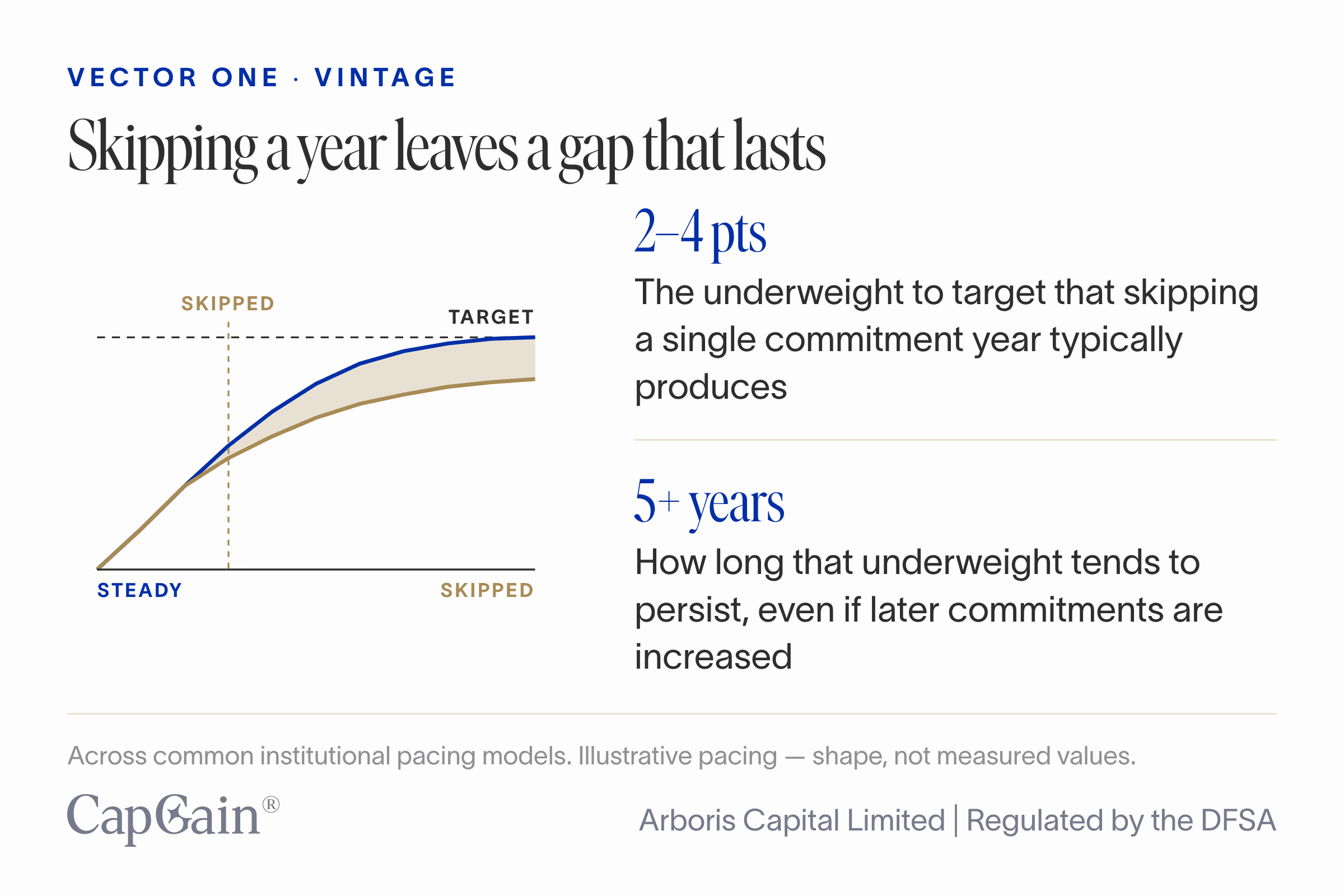
The mechanics play out the same way across strategies. Consider a portfolio targeting 15% exposure to illiquid alternatives with steady annual commitments: exposure gradually builds toward that target as capital is deployed. Skip one commitment year, and the portfolio loses an entire future cohort of deployment. Meanwhile, mature funds continue distributing capital back, pulling exposure downward. New commitments cannot simply catch up, because they deploy slowly and on GP pacing, not investor intention.
Across common institutional pacing models, skipping a single vintage typically produces a two-to-four percentage point underweight relative to target — and that gap often persists for five or more years, even if subsequent commitments are increased. This is not a performance issue; it is a structural allocation issue.
The case for staying committed through downturns
The temptation to pause commitments tends to peak precisely when conditions look most uncertain — rising rates, falling public markets, macro volatility. But pulling back in those moments carries a specific cost: missing the vintages that have historically performed best.
Private equity has consistently generated some of its strongest returns from recession-era vintages. Analysis by CAIS using Preqin data covering the 2001 dot-com crash and the 2008–2009 global financial crisis shows that, across most strategies and percentile levels, funds incepted in recession years averaged the highest net multiple returns compared to funds launched in the three preceding years.¹
PitchBook data reinforces this: the 2001 vintage is widely identified as a peak year for PE fund multiples, with a median TVPI of 2.14x. Separately, Bain & Company analysis cited by PitchBook found that buyout funds generated median IRRs of 25%, 40%, and 47% in the three years immediately following the dot-com crash.²
Cambridge Associates data corroborates the pattern across a longer timeframe: private equity funds with first cash flows in 2001–2003 and 2009–2011 achieved net distribution-to-paid-in (DPI) multiples of at least 2x — a benchmark that many pre-crisis vintages did not reach.³
The mechanism is consistent across downturns. When capital retreats broadly, deal flow continues but competition for assets thins. Entry multiples compress, and managers with dry powder can deploy into dislocated valuations. Staying committed year after year ensures participation in those rebound phases. Short-term caution at the point of maximum uncertainty is often precisely what prevents investors from capturing the upside that follows.
2. Strategy diversification: Building the economic mosaic
The second vector recognises that private markets are not monolithic. The asset class spans a range of strategies, each responding differently to the macro environment:
Private equity and growth strategies, focused on operational transformation and long-term value creation
Private credit, reflecting income dynamics, lending conditions, and corporate balance-sheet trends
Real assets and infrastructure, linked to physical assets, policy cycles, and inflationary regimes
Venture capital, reflecting innovation cycles and technological adoption rates
Secondaries and hybrid vehicles, offering differentiated risk and liquidity profiles
Blending these strategies means that no single economic regime — low rates, high rates, inflationary periods, innovation booms, M&A slowdowns — dominates the portfolio’s performance. Each strategy responds to a different set of conditions. Together, they create a portfolio that mirrors the complexity of the real economy rather than betting on any single phase of it.

3. Manager diversification: the human factor
The third vector acknowledges that no two general partners are alike — and that in private markets, the choice of manager matters considerably more than in public ones.
In public markets, manager dispersion is relatively contained. Large-cap equities show a spread of roughly three percentage points between the 75th and 25th percentile managers — a narrow band that reflects the efficiency of publicly traded assets. Private markets are different. According to J.P. Morgan data covering the period from 1Q16 to 2Q26⁴, the dispersion across private strategies is substantially wider.

The implication is direct: in private markets, manager selection is not a secondary consideration. It is one of the primary determinants of outcome. A top-quartile private equity manager has historically delivered returns roughly nineteen percentage points above a bottom-quartile peer over the same period. That gap does not exist in bonds or large-cap equities.
Each GP brings distinct sourcing networks, sector expertise, and operational philosophy. Concentrating too heavily on one manager — even one with a strong track record — compounds exposure to their specific approach and blind spots. Allocating across multiple managers broadens the decision-making base and reduces the risk that any single team’s judgement drives the entire outcome.
The discipline of allocation
What ties these three vectors together is not sophistication — it is consistency. Allocating every year, across strategies and managers, through economic uncertainty and market noise, requires conviction. Diversification done properly is not passive; it is an active expression of long-term belief in the compounding logic of private markets.
For investors building portfolios that will last decades, the three vectors are not independent levers. They work together: vintage discipline ensures continuous deployment, strategy breadth ensures resilience across regimes, and manager diversification ensures the quality of execution across each. The private markets reward those who understand this — not by owning a bit of everything, but by constructing a portfolio designed to perform across time.
Evergreen funds: diversification by design
For investors who want exposure to private markets without navigating the full complexity of vintage sequencing and manager selection independently, evergreen structures offer a structurally different starting point.
An open-ended fund that has been operating for several years already holds positions across multiple deployment cohorts. An investor subscribing today gains immediate exposure to that existing portfolio — assets at different stages of maturity, acquired at different points in the cycle, and in some cases sourced from different managers or via secondaries. The vintage diversification that a drawdown investor builds over years of disciplined commitment can, in an evergreen structure, exist from day one of allocation.
Some evergreen vehicles also allocate across multiple underlying managers or strategies within a single vehicle. Where that is the case, the investor gains not only vintage breadth but manager diversification — without the operational overhead of building and maintaining a multi-manager programme independently.
This does not remove the need for manager selection at the vehicle level — choosing which evergreen fund to allocate to remains a consequential decision. But it changes the terms of the problem: rather than constructing diversification from scratch across a sequence of commitments over a decade, the investor can access a pre-built, continuously managed portfolio through a single allocation.
Sources
1. CAIS, “When Might ‘Golden Vintages’ Appear in Private Markets?”, January 24, 2023, Accessed June 2026, https://www.caisgroup.com/articles/when-might-golden-vintages-appear-in-private-markets
2. PitchBook, “Are we in the eye of a golden vintage year?”, May 10 2024, Accessed June 2026, https://pitchbook.com/news/articles/limited-partners-funds-golden-vintage-year
3. Cambridge Associates, Andrea Auerbach, Keirsten Lawton CFA, Caryn Slotsky, “US Private Equity Looking Back, Looking Forward: Ten Years of CA Operating Metrics”, November 3, 2022, Accessed June 2026, https://www.cambridgeassociates.com/insight/us-private-equity-looking-back-looking-forward-ten-years-of-ca-operating-metrics/
4. J.P. Morgan, Guide to Alternatives, 1Q26, https://am.jpmorgan.com/content/dam/jpm-am-aem/global/en/insights/market-insights/guide-to-alternatives/mi-guide-to-alternatives-us.pdf
Written by
Disclaimer – For Professional Clients Only
This communication is intended solely for persons classified as Professional Clients as defined by the Dubai Financial Services Authority (DFSA). It is not directed at Retail Clients and should not be relied upon by any person who does not meet the criteria for classification as a Professional Client. The information provided herein is for general informational purposes only and does not constitute, and should not be construed as, an offer, solicitation, invitation, or recommendation to buy, sell, or otherwise transact in any investment product or to engage in any investment strategy.
The subject matter discussed does not relate to a DFSA-regulated financial product or service. The content is intended only to provide a general update on market conditions and does not consider the specific investment objectives, financial situation, or particular needs of any recipient. It should not be relied upon as the basis for any investment decision. Past performance is not a reliable indicator of future performance. The value of investments and any income from them may fluctuate, and there is no assurance that the original capital will be preserved or returned.
Although the information contained in this communication has been obtained from sources believed to be reliable, Arboris Capital Limited makes no representation or warranty as to its accuracy, completeness, or fitness for any particular purpose. No liability is accepted by Arboris Capital Limited, its employees, or affiliates for any direct or consequential loss arising from the use of or reliance on this material. Arboris Capital Limited is authorised and regulated by the Dubai Financial Services Authority (DFSA) and operates within the Dubai International Financial Centre (DIFC), United Arab Emirates.