Evergreen fund assets have grown to around USD 653 billion, more than doubling since 2022. This Q3 2026 update looks at how the market handled its first liquidity test in private credit, why growth is shifting toward private equity and venture capital, and what the deepening pipeline means for investors.

A USD 650 billion market, still compounding. Net evergreen fund assets reached about USD 653 billion in 2026, up from USD 277 billion in 2022 — even as fundraising for traditional drawdown funds has fallen for five straight years.¹
The first stress test, and what it taught. Private credit evergreens met redemption pressure from late 2025. Early-2026 headlines read like a crisis; the better reading is that the non-traded structure’s repurchase caps did what they are built to do, meeting repurchases up to the cap and prorating demand above it.² The mechanism is now better understood, though some credit funds continue to prorate redemptions.¹
The growth engine has rotated. Credit built the market and has now levelled off. Private-equity evergreen NAV doubled between end-2024 and mid-2026, and venture-capital evergreen grew from about USD 3 billion to over USD 20 billion as AI and technology exposure drew new capital.¹
A deepening pipeline. More than 100 pre-launch funds are in the works, led by blended and structured credit and by multi-asset vehicles — product design maturing beyond plain direct lending.¹
Three years ago, evergreen funds were a promising footnote to private markets. Today they are a USD 650 billion category with a pipeline of more than a hundred funds waiting to launch — and, as of 2026, a first genuine liquidity test behind them, one the market now understands better even as some credit funds continue to prorate redemptions. This note updates where the market stands on the latest data, why the growth engine has shifted from credit to equity, and what it means for investors accessing private markets through an open-ended wrapper.
A USD 650 billion market that keeps compounding
The net asset value of the evergreen universe that PitchBook and Morningstar track reached about USD 653 billion in 2026, up from USD 277 billion in 2022 — more than double in four years.¹
Growth has continued through 2026, though at a slower pace than in prior years and against considerable uncertainty.¹The backdrop makes the trajectory more striking: fundraising in the traditional drawdown-fund world has declined for five straight years, so evergreen structures are absorbing capital; the closed-end model no longer wins as easily.¹

The first stress test — and what it taught
The test came through private credit, and it is worth being precise about where it landed. The loud, daily version of private-credit stress — sharp moves and discounts to net asset value — is structurally a listed-market event: publicly-traded vehicles reprice in real time, so their share price can fall to a discount. The non-traded evergreen structures experienced something quieter. Redemption requests ran ahead of what some funds would repurchase in a given window, and the caps did what they are designed to do: repurchases were met up to the cap and demand above it was prorated.²
PitchBook’s conclusion is measured rather than triumphant. The liquidity mechanism is now better understood, and although some credit funds continue to prorate redemption demand, the intensity has mellowed.¹

Proration is a real constraint on the investor: it defers access to capital. It is also a rules-based limit, set out in the offering documents, that spares the fund from selling assets into a falling market to meet outflows. Some exposure remains: an investor who needs to exit between windows, or whose fund later converts to a listed vehicle, can still realise less than net asset value.² Because the caps are disclosed before subscribing, semi-liquid funds suit capital that can wait one or more windows to come out, and fit poorly with money that may be needed on demand.

The rotation: credit built the market, equity is growing it now
The most important shift in the latest data is where new money is going. Credit built the evergreen market, but its largest structure has stopped growing: non-traded business development companies — mostly direct-lending vehicles — edged down from USD 204.9 billion to USD 203.1 billion between 2025 and 2026 as outflows bit.¹
Equity has taken the baton. Private-equity evergreen NAV doubled between the end of 2024 and PitchBook’s June 2026 reading, prompting a dedicated “rise of evergreen PE” spotlight in the report.¹ Venture-capital evergreen has grown faster still from a smaller base: from about USD 3 billion in 2024 to over USD 20 billion in the latest reading, as AI and technology exposure drew new capital.¹ The commercial signal is clear — the wrapper that was first built, and first tested, in credit is now being built out across the return-seeking end of private markets.

The structures, by assets
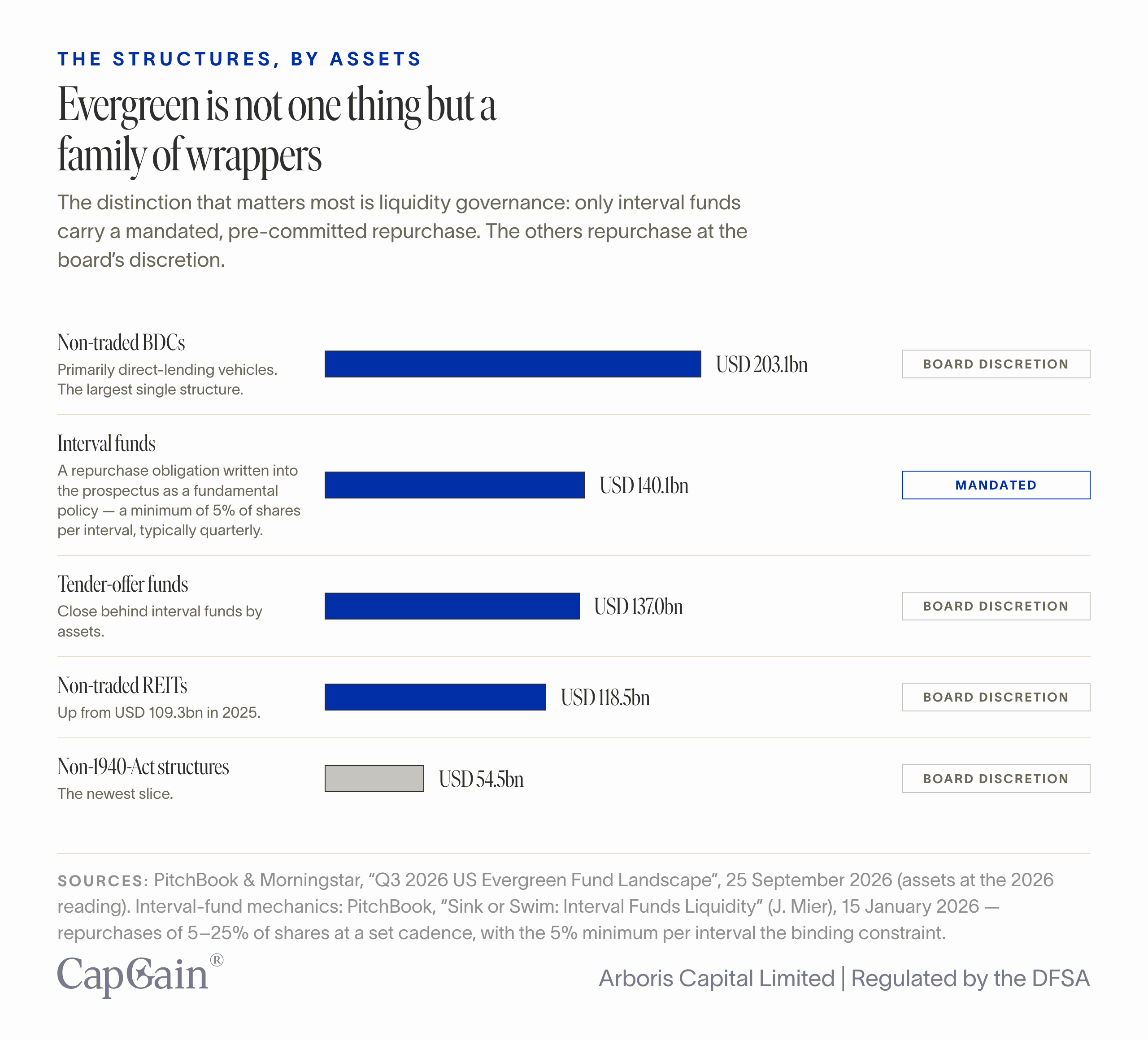
Evergreen is not one thing but a family of wrappers. By assets at the 2026 reading:¹
Non-traded BDCs — USD 203.1 billion, the largest single structure, primarily direct-lending vehicles (repurchases at the board’s discretion).
Interval funds — USD 140.1 billion, the only structure with a repurchase obligation written into the prospectus as a fundamental policy — a minimum of 5% of shares per repurchase interval, typically quarterly.²
Tender-offer funds — USD 137.0 billion, close behind, with repurchases at the board’s discretion.
Non-traded REITs — USD 118.5 billion, up from USD 109.3 billion in 2025.
Non-1940-Act structures — USD 54.5 billion, the newest slice.
The distinction that matters most is liquidity governance: only interval funds carry a mandated, pre-committed repurchase; the others repurchase at the board’s discretion.
The pipeline, and the access story
Depth is building ahead of the headline number. PitchBook now tracks funds before they launch, and as of mid-September 2026 the pipeline held more than 100 pre-launch funds.¹ Two features stand out.
First, alternative credit is the dominant category among pre-launch funds — product design in debt is shifting toward blended and structured credit and away from plain direct lending.¹
Second, private multi-asset funds are gaining ground — vehicles that invest across private asset classes, often by owning existing evergreen funds, pointing to an “open-architecture” future in which a single wrapper delivers a diversified private-markets portfolio.¹
Regulation is moving in the same direction. In September 2026, the SEC proposed giving interval funds more flexibility to schedule repurchases around the liquidity of their portfolios, the mechanism tested in the credit stress episode. It also proposed changes that could bring more private-equity and venture managers into the structure.³ Both remain at proposal stage.
In Europe, the ELTIF framework is drawing interest beyond the EU: managers are launching ELTIFs aimed at Asian wealth clients, and Asian and Middle Eastern investors are a growing share of demand for European private credit.⁴ Singapore has consulted on a comparable long-term investment fund regime for retail investors.⁵
What it gives the investor
What the wrapper offers is not a higher return — that depends on the manager and the assets — but a more usable shape of access. Capital is typically put to work from day one rather than drawn down over several years, which can reduce the J-curve wait. A single subscription can provide a diversified, professionally managed private-markets portfolio without the operational load of capital calls, staggered distributions and multiple tax forms.
Minimums sit below a traditional closed-end commitment, and liquidity — capped, but periodic rather than locked for a decade — makes the exposure easier to size, rebalance and fit to a mandate. For an allocator building private-markets exposure for the first time, or adding to it efficiently, that combination is the attraction.

The record, meanwhile, is still being written. Credit has the longest track record, which is part of why it built the market first; the equity and multi-asset records are shorter and will be judged over a full cycle. No performance claim belongs here — realised returns vary by manager, strategy and vintage, and sit in fund-level documentation assessed on its own terms. What the data does show is demand: capital is moving toward the structure, and the pipeline is deepening behind it.
What it means
Evergreen funds have moved beyond novelty to become an increasingly established route into private markets. The market is larger, the structures better understood, and the first liquidity test now largely sits behind the market rather than ahead of it — not without strain, but without systemic failure. For private wealth — including the GCC capital CapGain serves — this one route into private markets, which trades some of the administrative load of capital calls for capped, periodic liquidity. is a practical route into private markets: a single, open-ended wrapper rather than a ten-year drawdown commitment.
Two things keep the view honest. The liquidity is real but capped — these are semi-liquid, not liquid, vehicles, and the gap between the two is where investor disappointment lives. And the rotation into PE and VC evergreen is promising but young; selection of manager, structure and strategy matters more than exposure to the category. CapGain’s role is disciplined access — matching GCC capital to the vehicles whose liquidity terms and underlying portfolios actually fit the mandate, not blanket exposure to a label that now spans everything from direct lending to venture capital.
Sources:
PitchBook & Morningstar, “Q3 2026 US Evergreen Fund Landscape” (J. Mier, H. Wiek, S. Buibish et al.), 25 September 2026. Data aggregated 15 September 2026; disclosure documents dated 31 December 2025 – 30 June 2026, https://pitchbook.brightspotcdn.com/5d/66/6700a388486793385c784b54791b/q3-2026-us-evergreen-fund-landscape-preview.pdf
PitchBook, “Sink or Swim: Interval Funds Liquidity” (J. Mier), 15 January 2026 (interval-fund repurchases of 5–25% of shares at a set cadence, with a 5% minimum per interval the binding constraint), https://pitchbook.brightspotcdn.com/d5/20/4409c0b44d7a87601cbdbb1376a5/q1-2026-pitchbook-analyst-note-sink-or-swim-interval-funds-liquidity.pdf
US Securities and Exchange Commission, “SEC Proposes Amendments to Expand Responsible Retailization of Private Markets,” press release 2026-96, 30 September 2026, Accessed October 22 2026, https://www.sec.gov/newsroom/press-releases/2026-96-sec-proposes-amendments-expand-responsible-retailization-private-markets
Sascha Steffen (Frankfurt School of Finance & Management), “Europe’s Private Credit Fundraising Just Hit a Record — and ELTIF 2.0 Has Opened a Second Fundraising Dimension,” commentary, 27 July 2026 (about 29% of Tikehau DL VI capital from Asian and Middle Eastern LPs; Apollo authorised three sister ELTIFs for EMEA, Asia and LatAm wealth clients; based on a dataset of 62 European private-credit fundraising events, January 2025 – July 2026), Accessed October 23 2026, https://www.sascha-steffen.de/commentary/europes-private-credit-fundraising/
Monetary Authority of Singapore, “MAS Proposes a Regulatory Framework for Retail Private Market Investment Funds,” media release, 27 March 2025 (consultation on a proposed Long-term Investment Fund (LIF) framework with Direct Fund and fund-of-funds (LIFF) structures; consultation closed 26 May 2025), Accessed October 23 2026, https://www.mas.gov.sg/news/media-releases/2025/mas-proposes-a-regulatory-framework-for-retail-private-market-investment-funds

Written by
Sarah Hansen
Head of Research
Disclaimer – For Professional Clients Only
This communication is intended solely for persons classified as Professional Clients as defined by the Dubai Financial Services Authority (DFSA). It is not directed at Retail Clients and should not be relied upon by any person who does not meet the criteria for classification as a Professional Client. The information provided herein is for general informational purposes only and does not constitute, and should not be construed as, an offer, solicitation, invitation, or recommendation to buy, sell, or otherwise transact in any investment product or to engage in any investment strategy.
The subject matter discussed does not relate to a DFSA-regulated financial product or service. The content is intended only to provide a general update on market conditions and does not consider the specific investment objectives, financial situation, or particular needs of any recipient. It should not be relied upon as the basis for any investment decision. Past performance is not a reliable indicator of future performance. The value of investments and any income from them may fluctuate, and there is no assurance that the original capital will be preserved or returned.
Although the information contained in this communication has been obtained from sources believed to be reliable, Arboris Capital Limited makes no representation or warranty as to its accuracy, completeness, or fitness for any particular purpose. No liability is accepted by Arboris Capital Limited, its employees, or affiliates for any direct or consequential loss arising from the use of or reliance on this material. Arboris Capital Limited is authorised and regulated by the Dubai Financial Services Authority (DFSA) and operates within the Dubai International Financial Centre (DIFC), United Arab Emirates.