Private equity follows a defined lifecycle—from fundraising and capital commitments to investment, value creation, and exit. This walkthrough explains how capital is raised, deployed, and actively managed over time, and how returns are ultimately realised and distributed to investors. It breaks down each stage of the process, clarifying how private equity turns long-term ownership into value creation.

Private equity follows a defined lifecycle: raise → invest → grow → exit → return.
GPs raise committed capital from LPs but only draw it as needed (via capital calls).
Investments are sourced, screened, and deeply vetted through due diligence.
Once deployed, capital is used to acquire stakes and drive value creation in portfolio companies.
PE firms actively manage companies over a 5–7 year holding period to increase enterprise value.
Exits typically occur through IPOs, strategic sales, or secondary buyouts.
Setting the stage: Fundraising and capital commitments
The process begins well before any investment is made. An investment manager—also known as a general partner (GP)—markets a new fund to potential investors, laying out their strategy, risk appetite, and expected returns.
These investors (limited partners or LPs) might include high-net-worth individuals, pension funds, sovereign wealth funds, or family offices. Each LP decides how much they are willing to commit, in principle, to the fund. These are capital commitments, not cash transfers—yet.
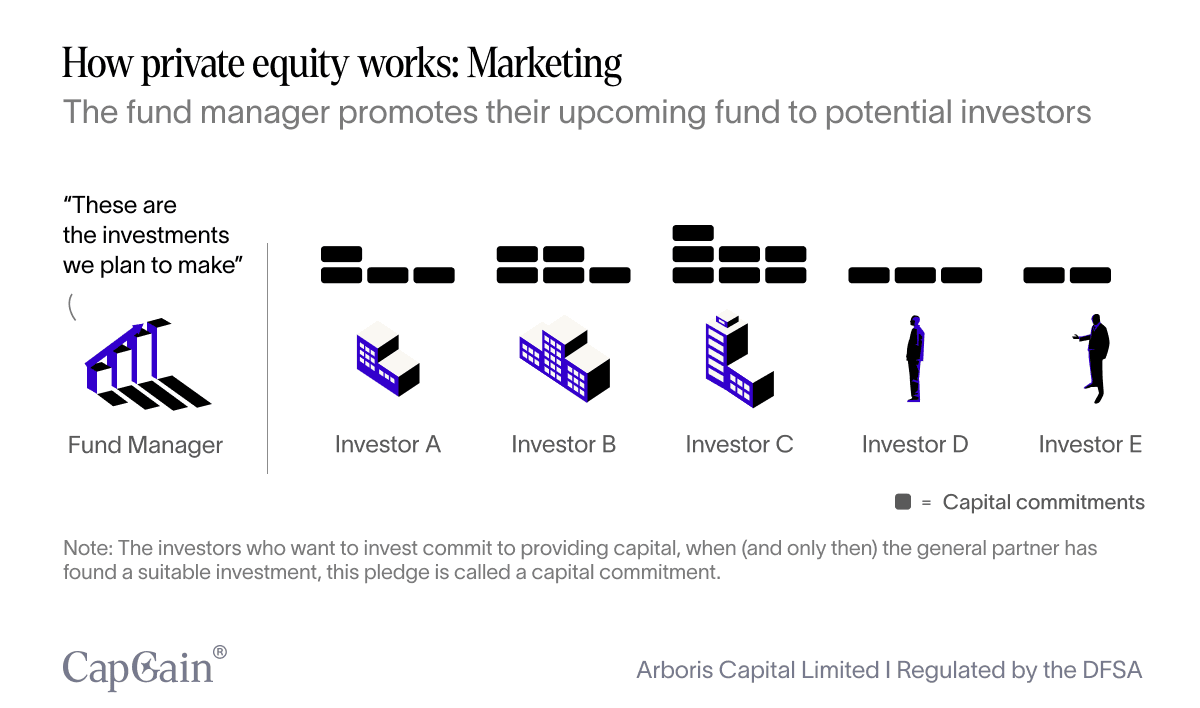
Once the fund has secured enough commitments to meet its target size, it formally closes to new investors and moves into its deployment phase.
Deal Flow: Sourcing, screening, and selection
With capital pledged but not yet drawn, the GP begins sourcing potential investments—companies that align with the fund’s investment thesis. Screening helps filter out unsuitable targets, focusing on those that pass key criteria.
Once a promising target is found, the team conducts due diligence, an exhaustive review of the company’s operations, financials, legal risks, and market positioning.
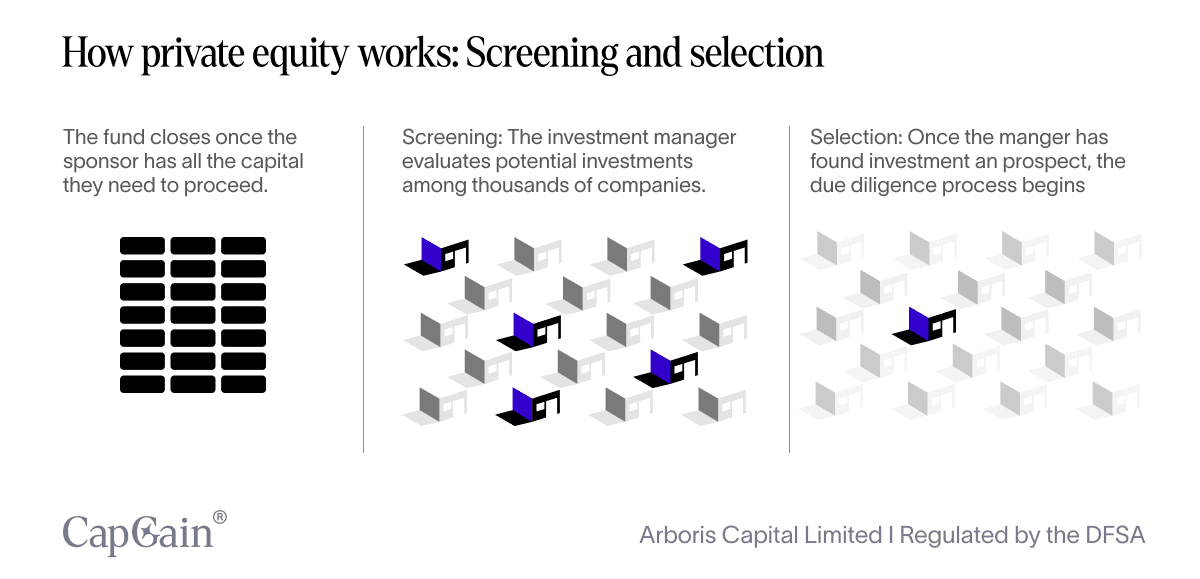
If the company makes it through due diligence, the investment firm makes an offer, also known as a term sheet. If the company accepts the terms, the investment proceeds. To finance this investment, the investment manager needs capital from their investors.
Deployment: Capital at work
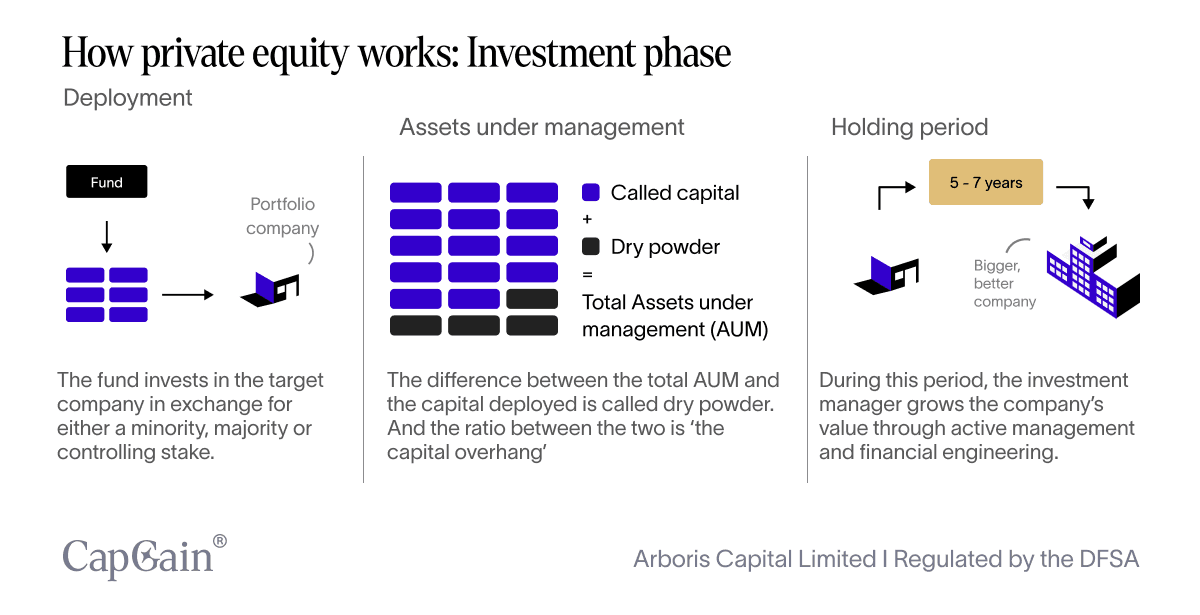
Once the investment is made, the capital is officially deployed. The PE firm takes a stake—minority or majority, depending on strategy—and begins the real work: value creation. This might involve installing new leadership, restructuring operations, expanding into new markets, or improving margins through tighter cost control.
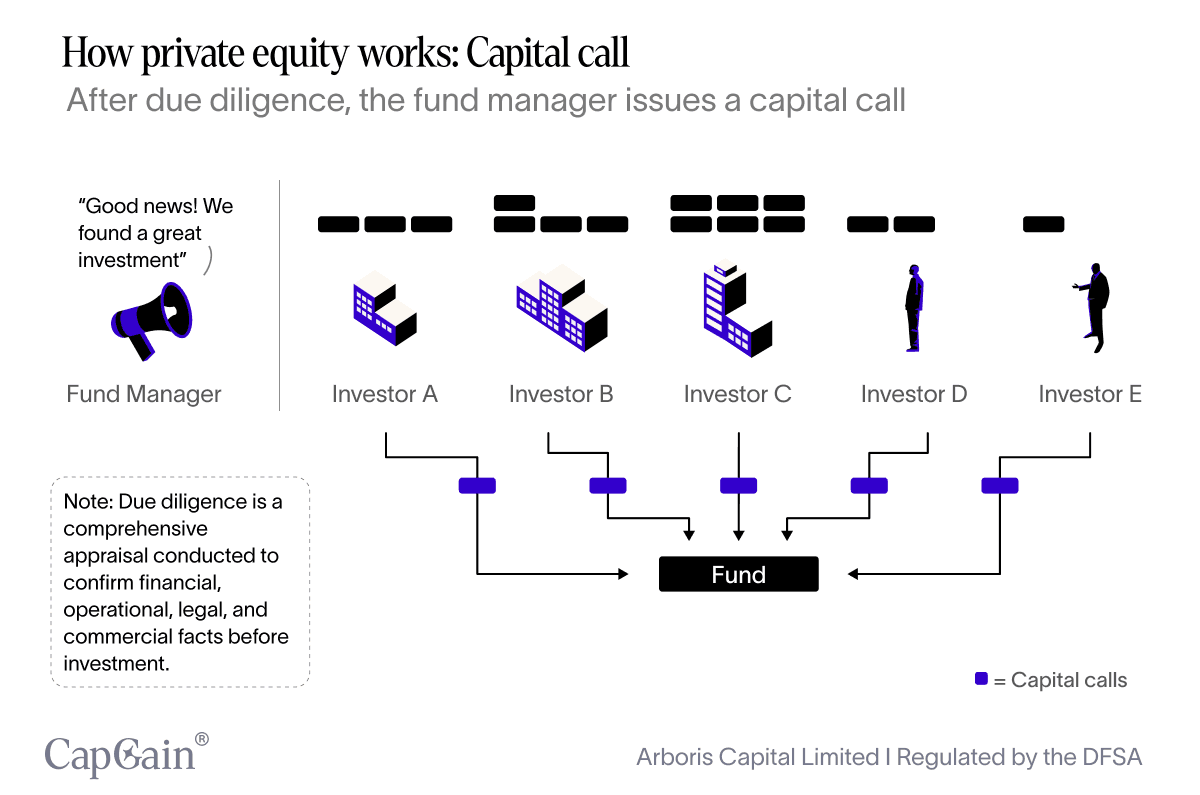
The uncalled capital remains as dry powder—a term for money that’s been committed but not yet deployed. It's this reserve that allows a PE fund to continue investing over time. The total capital under management is referred to as Assets Under Management (AUM), which includes both deployed capital and dry powder.
The holding period: Building value
A typical holding period ranges between five to seven years. During this time, the firm actively manages the company, engineering growth, and profitability improvements. The aim is to transform the company into a significantly more valuable enterprise, justifying a higher exit valuation later on.
Think of this period as the gestation phase: the company is reshaped, groomed, and positioned for its next stage—liquidity.
Exit: Realising the investment
Once the target company has reached its value potential—or market conditions become favorable—the PE firm looks to exit. This may happen through an IPO, a trade sale to a strategic buyer, or a secondary sale to another PE sponsor.
This marks the culmination of the investment cycle. The company is sold, and the capital flows back to the fund.
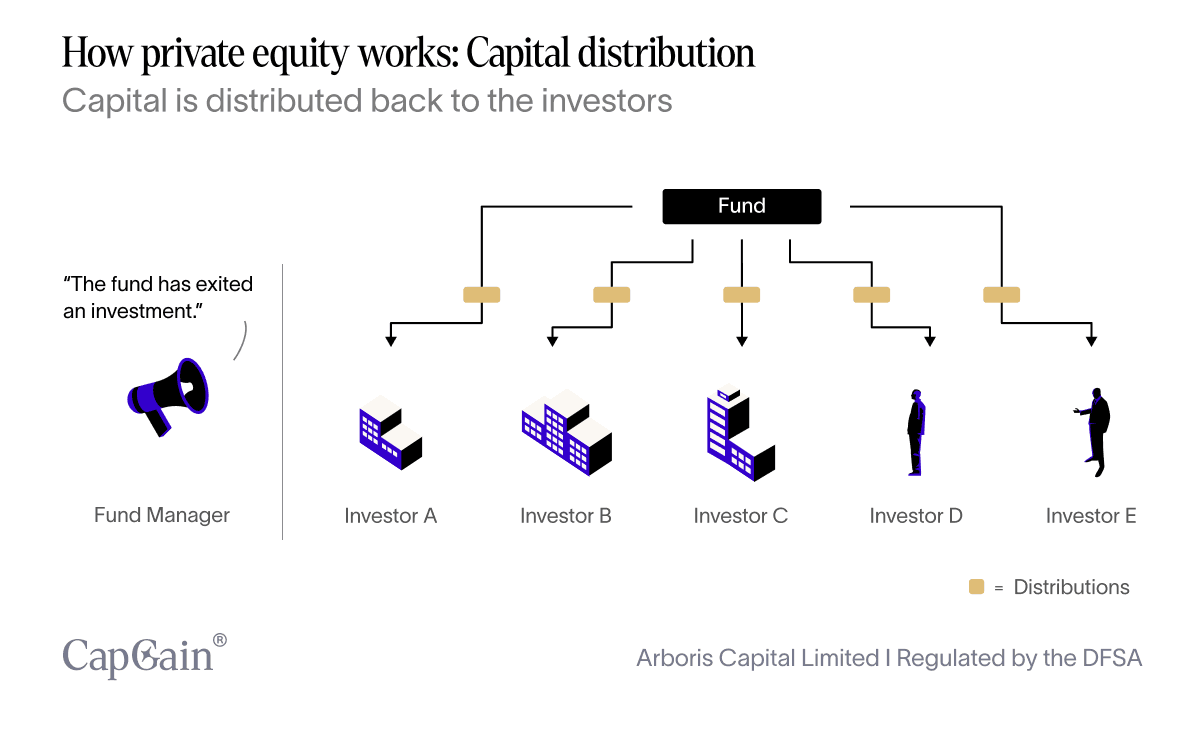
Distribution: Returning capital to investors
Following the exit, the fund returns capital to its investors. These are called distributions, and they represent the realisation of the investor’s share of the fund’s profits (or losses). If a fund has made multiple investments over time, capital calls and distributions may be staggered accordingly.
Final thoughts
Uncovering the layers of private equity can feel opaque by design. Between commitments, capital calls, and exits that unfold over a decade, it’s easy to lose sight of how the machine actually works.
This primer is meant to demystify the lifecycle—showing how capital moves from promise to deployment to realised return.
If you want to go deeper—into fund structures, performance metrics, risk dynamics, and where private equity fits within a broader portfolio—explore our private equity masterclass series, where each layer is unpacked with the same clarity and discipline.
Written by
Sarah Hansen
Head of Research
Disclaimer – For Professional Clients Only
This communication is intended solely for persons classified as Professional Clients as defined by the Dubai Financial Services Authority (DFSA). It is not directed at Retail Clients and should not be relied upon by any person who does not meet the criteria for classification as a Professional Client. The information provided herein is for general informational purposes only and does not constitute, and should not be construed as, an offer, solicitation, invitation, or recommendation to buy, sell, or otherwise transact in any investment product or to engage in any investment strategy.
The subject matter discussed does not relate to a DFSA-regulated financial product or service. The content is intended only to provide a general update on market conditions and does not consider the specific investment objectives, financial situation, or particular needs of any recipient. It should not be relied upon as the basis for any investment decision. Past performance is not a reliable indicator of future performance. The value of investments and any income from them may fluctuate, and there is no assurance that the original capital will be preserved or returned.
Although the information contained in this communication has been obtained from sources believed to be reliable, Arboris Capital Limited makes no representation or warranty as to its accuracy, completeness, or fitness for any particular purpose. No liability is accepted by Arboris Capital Limited, its employees, or affiliates for any direct or consequential loss arising from the use of or reliance on this material. Arboris Capital Limited is authorised and regulated by the Dubai Financial Services Authority (DFSA) and operates within the Dubai International Financial Centre (DIFC), United Arab Emirates.