Industry-level risks narrow the focus from macro conditions to sector-specific dynamics such as regulation, technological change, and competitive intensity. These forces often determine how value can be created — or destroyed — within a given industry. For private equity (and venture capital) investors, understanding industry risk means analysing context rather than relying on precedent, and working actively with portfolio companies to navigate complexity over time.

Industry-level risks in private equity differ from macro-level risks by focusing on sector-specific dynamics.
Key industry risks include regulatory shifts, technological disruption, and competitive intensity.
Private equity's active management model gives portfolio companies a strategic edge in navigating industry-specific challenges.
Regulatory risk is mitigated through expert networks and tailored compliance strategies.
Technological risks are addressed through operational integration and innovation investment.
Competitive risks are managed via long-term planning, strategic partnerships, and market repositioning.
Industry risks
While macro-level risks provide a broad overview of the economic and market forces affecting investments, industry-level risks narrow the focus to the particular characteristics of each sector. These may include regulatory changes, technological disruption, or shifts in competitive intensity.
For investors, recognising these dynamics is essential. Sector-level challenges are often decisive in shaping portfolio outcomes, and private equity’s value proposition lies in its ability to work directly with portfolio companies to address them. Still, no two industries — or indeed, no two investments — carry the same profile. Understanding industry risk, therefore, means looking at the specific context, rather than assuming that past outcomes in one case will be repeated elsewhere.
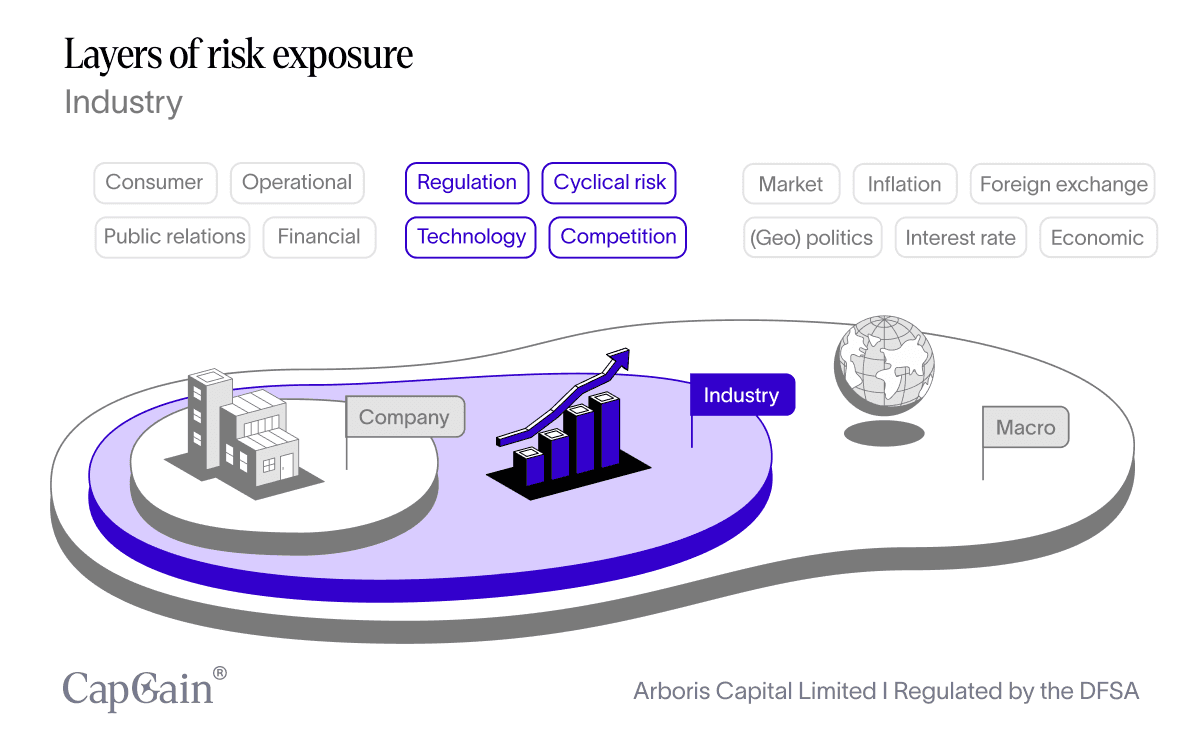
In this article, we examine the key types of industry-level risks and highlight how private equity firms, through their active management approach, may help portfolio companies navigate them. The case studies that follow illustrate how regulatory, technological, and competitive risks have been managed in practice — but they should be viewed as examples of what has been possible in specific circumstances, not as templates for future results.
Regulatory risks
Different industries are subject to varying degrees of regulatory oversight, but no one is exempt. The healthcare sector faces stringent regulatory requirements for product approvals and patient care standards. The financial services sector is heavily regulated in terms of capital requirements and compliance standards. The list goes on.
Of course, this applies to both private and public equity investing. And yet, companies under private equity or venture capital stewardship have a unique advantage. For one, being out of the spotlight, they can address regulatory challenges without public scrutiny.
Second, PE and VC firms provide more than just capital to their portfolio companies. Through their team of in-house experts as well as their extensive (and exclusive) network of industry experts and insiders, sponsors offer their portfolio companies unmatched access to guidance across a range of areas, from operations and marketing to IT and tax.
This includes legal aid. These experts have an in-depth understanding of various regulatory frameworks across a range of jurisdictions. This comparative advantage can give portfolio companies a significant upper hand and – in some instances – make or break their business case.
Airbnb case study
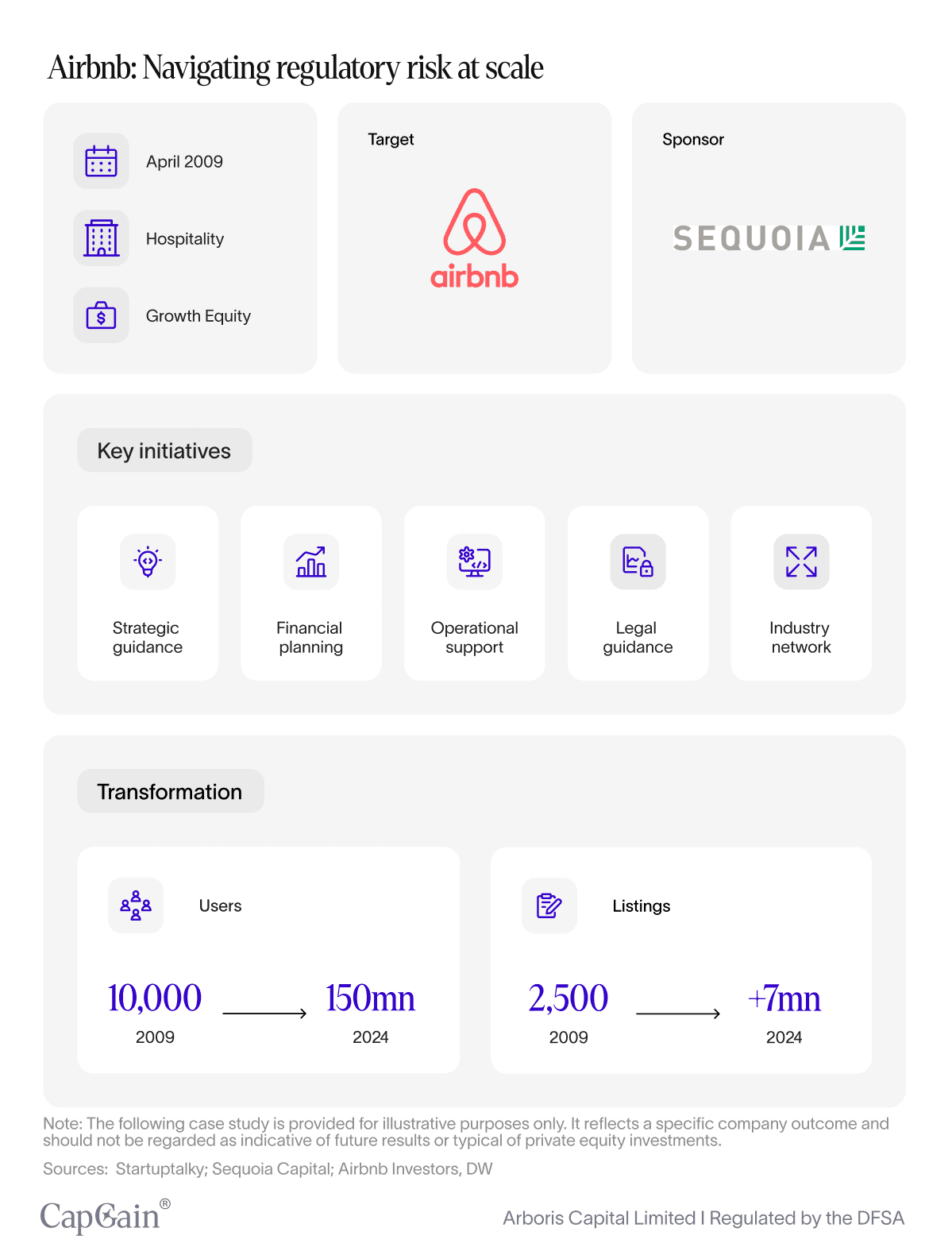
Sequoia Capital’s involvement with Airbnb provides a clear example of how venture capital can play a strategic role in managing regulatory risks.
Airbnb, founded in 2008¹, revolutionised the hospitality industry by creating an online platform that allowed people to rent out their homes or rooms to travellers. While the business model was groundbreaking, it also quickly attracted regulatory scrutiny. Short-term rentals, the core of Airbnb’s business, were subject to varying degrees of regulation in different jurisdictions around the world, from city-level ordinances to national laws. These regulations often addressed issues such as zoning, taxation, health and safety standards, and the impact on local housing markets.
As Airbnb expanded, the regulatory landscape became increasingly complex. Cities like New York, San Francisco, and Barcelona introduced strict regulations limiting short-term rentals, driven by concerns over housing affordability, neighbourhood character, and the impact on traditional hotel businesses. Airbnb faced fines, lawsuits, and in some cases, outright bans on its operations in certain areas.
Sequoia Capital, an early and prominent investor, played a pivotal role in guiding Airbnb through these regulatory challenges. Sequoia's partnership with Airbnb commenced in April 2009 with an initial seed investment of USD 585,000². Their involvement can be understood through several key strategies:
Strategic guidance and advocacy
Sequoia Capital’s experience in scaling companies in regulated industries provided Airbnb with valuable strategic guidance. The firm helped Airbnb develop a more sophisticated approach to dealing with regulatory bodies, including lobbying for favourable policies and engaging in public relations campaigns to shape public opinion and influence policymakers.
For example, Sequoia helped Airbnb identify and prioritise key markets where the regulatory battles were most intense, such as New York City and San Francisco. By focusing resources on these critical regions, Airbnb could work more effectively to influence regulations that allowed for its continued operation.
Local compliance and adaptation
As Airbnb expanded globally, it became clear that a one-size-fits-all approach to regulation would not work. Sequoia Capital advised Airbnb to adopt a more localised strategy, tailoring its operations and compliance efforts to the specific regulatory environments of each market.
This approach led Airbnb to create city-specific policies and agreements. In some cities, Airbnb agreed to collect and remit local occupancy taxes, a move that helped to placate regulators and integrate Airbnb more seamlessly into the local hospitality ecosystem. In other locations, Airbnb adjusted its platform to limit the number of nights a property could be rented or to require hosts to register with local authorities.
Investment in legal and regulatory infrastructure
Under Sequoia’s guidance, Airbnb significantly invested in building a robust legal and regulatory team. This team was tasked with staying ahead of regulatory developments, engaging with lawmakers, and ensuring that Airbnb’s operations complied with local laws.
These investments also extended to public policy initiatives and community outreach. Airbnb began partnering with local governments to promote tourism and economic development, positioning itself as a positive force in communities rather than just a disruptive technology.
Outcome
Owing to Sequoia Capital’s strategic involvement, Airbnb was able to navigate the complex regulatory environments in multiple jurisdictions, where regulatory risks could have easily stifled its growth. This ability to manage and mitigate regulatory risks was crucial as Airbnb continued to expand globally, eventually leading to its successful IPO by the end of 2020.
Airbnb's Class A common stock began trading on the Nasdaq Global Select Market on December 10, 2020, under the ticker symbol "ABNB," with its IPO priced at USD 68.00 per share, raising approximately USD3.4 billion for the company.⁴
Technological risks
Technology is a double-edged sword. It can redefine industries, creating entirely new niche markets or inducing tectonic shifts in established sectors. Equally, it can disrupt and destroy industries.
Private equity firms' proximity to technological advancements allows them to effectively manage technological risks. Their ability to identify, invest in, and integrate new technologies can turn potential threats into significant opportunities for growth and value creation.
Being deeply integrated into the operational and strategic aspects of their portfolio companies, private equity firms can quickly identify technological trends and adapt their strategies accordingly.
Competitive landscape
The competitive landscape varies across industries, influencing the risk profile of investments. For example, the technology sector is characterised by rapid innovation and intense competition, while the energy sector faces competition from renewable energy sources and changing consumer preferences.
In competitive markets, private equity firms leverage their networks and resources to form strategic alliances and partnerships for their portfolio companies. This approach not only brings in additional capital but also provides access to new markets, technologies, and expertise, giving portfolio companies a competitive edge.
Dell case study
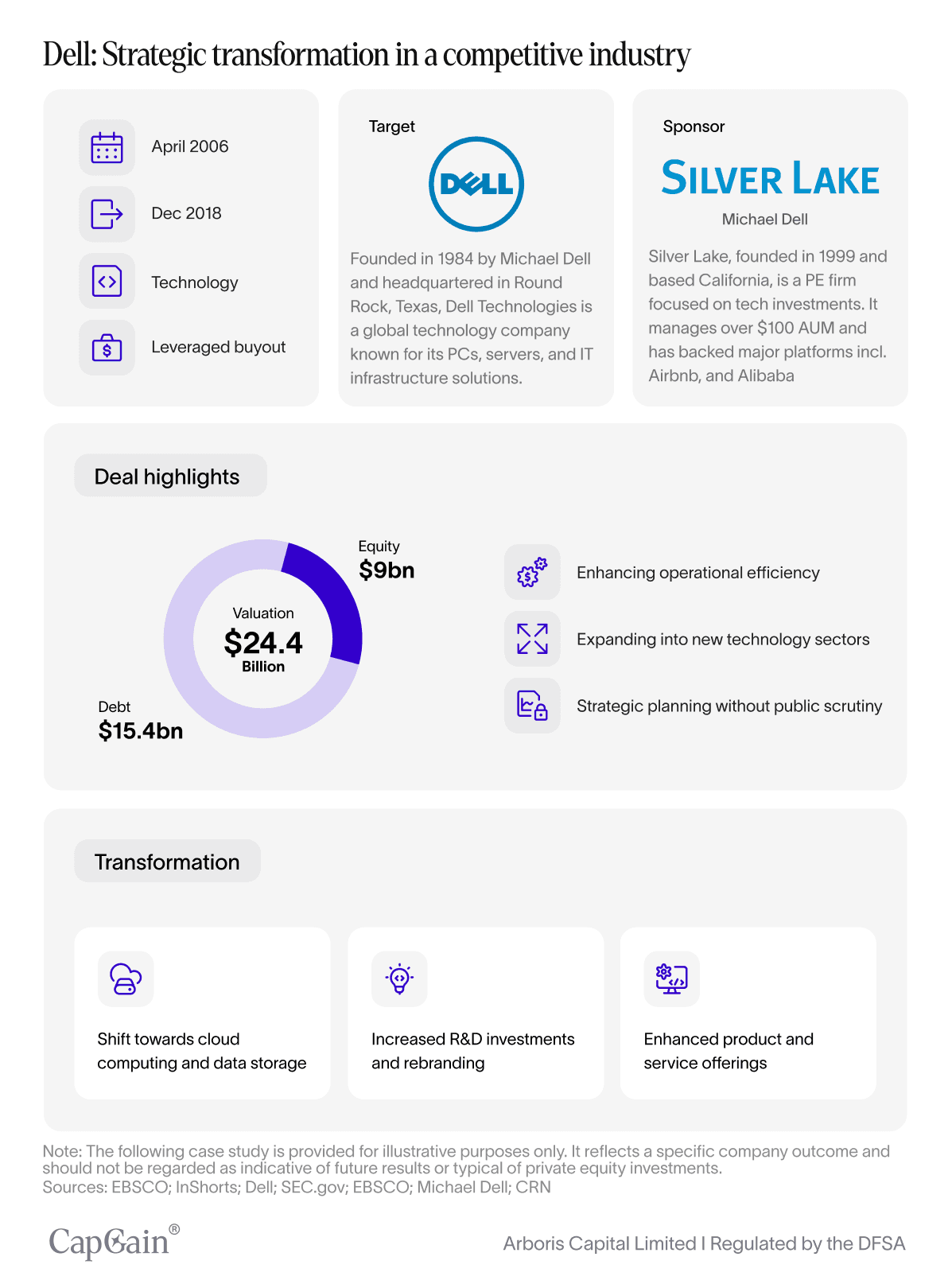
Dell, a well-known tech company, provides a compelling case study for how private equity can help companies in competitive industries where technological advantages form the very existential foundation.
Dell, founded by Michael Dell in 1984⁵, rapidly ascended to become a global leader in PC manufacturing after its initial public offering in 1988⁶.17 The company's IPO raised USD 30 million, giving it a market capitalisation of USD 85 million⁷.
However, by the early 2010s, Dell was struggling with declining sales due to the shifting market dynamics towards mobile devices and cloud computing. The company found it challenging to navigate these industry changes while under the constant scrutiny of public shareholders, who demanded consistent quarterly performance.
In 2013, Michael Dell, with the support of private equity firm Silver Lake Partners, took the company private in a USD 24.4 billion leveraged buyout.⁸
Free from ongoing performance pressure, Dell could focus on long-term investments in its enterprise solutions, cloud services, and software divisions—areas that required substantial upfront investments but promised higher returns in the future.
Core initiatives included the acquisition of EMC Corporation in 2016 for USD 67 billion⁹. This acquisition was instrumental in transforming Dell into a leading player in the data storage and cloud computing markets.
Ultimately, Dell returned to the public markets in 2018¹⁰. By then, it had reshaped its business, strengthened its market position, and achieved significant growth in its targeted areas.
Final thoughts
Private equity’s approach to risk is neither uniform nor formulaic. The Airbnb and Dell examples show that while regulatory and technological pressures can pose existential challenges, they can also become catalysts for transformation when paired with capital, expertise, and long-term vision.
There is no one-size-fits-all solution: each investment carries its own risk profile, shaped by market dynamics, industry cycles, and governance structures. What private equity brings is the ability to diagnose these risks early, deploy capital strategically, and mobilise operational change at scale.
But it’s important to remember: risk is never eliminated, only managed and repriced. Capital remains at risk, and outcomes are contingent on timing, execution, and external conditions that no investor controls.
Ultimately, the lesson is not that private equity offers a universal playbook for risk, but that its distinctive combination of proximity to management, access to capital, and strategic flexibility can make the difference between a company struggling to survive — and one positioned to thrive.
Startuptalky, Airbnb - Company Highlights, Accessed July 21 2025. https://startuptalky.com/airbnb-success-story/
Sequoia Capital, Airbnb IPO: Embracing the Adventure, December 10 2020, Accessed July 21 2025. https://www.sequoiacap.com/article/airbnb-ipo-embracing-the-adventure/
Airbnb Investors, Airbnb Announces Pricing of Initial Public Offering, December 9 2020, Accessed July 21 2025. https://investors.airbnb.com/press-releases/news-details/2020/Airbnb-Announces-Pricing-of-Initial-Public-Offering/default.aspx
DW, Airbnb Shares Sail Past IPO Price in Stellar Debut, December 10 2020, Accessed July 21 2025. https://www.dw.com/en/airbnb-shares-sail-past-ipo-price-in-stellar-debut/a-55881563
EBSCO, Dell Inc., Accessed July 21 2025. https://www.ebsco.com/research-starters/computer-science/dell-inc
InShorts, On This Day: Dell, Started by 19-Year-Old Michael Dell With $1,000, Went Public, June 22 2024, Accessed July 21 2025. https://inshorts.com/en/news/on-this-day--dell--started-by-19-year-old-michael-dell-with--1-000--went-public-1719062649042
Dell, Dell Technologies Timeline, Accessed July 21 2025. https://www.dell.com/en-us/dt/corporate/about-us/who-we-are/timeline.htm
SEC.gov, Form 8-K - Dell Inc., February 5 2013, Accessed July 21 2025. https://www.sec.gov/Archives/edgar/data/826083/000119312513038969/d480650dex992.htm
EBSCO, Michael Dell, Accessed July 21 2025. https://www.ebsco.com/research-starters/biography/michael-dell
CRN, Dell's Public Journey: From Private Equity Buyout To VMware Share Swap, October 15 2018, Accessed July 21 2025. https://www.crn.com/news/data-center/dell-s-public-journey-from-private-equity-buyout-to-vmware-share-swap

Written by
Sarah Hansen
Head of Research
Disclaimer – For Professional Clients Only
This communication is intended solely for persons classified as Professional Clients as defined by the Dubai Financial Services Authority (DFSA). It is not directed at Retail Clients and should not be relied upon by any person who does not meet the criteria for classification as a Professional Client. The information provided herein is for general informational purposes only and does not constitute, and should not be construed as, an offer, solicitation, invitation, or recommendation to buy, sell, or otherwise transact in any investment product or to engage in any investment strategy.
The subject matter discussed does not relate to a DFSA-regulated financial product or service. The content is intended only to provide a general update on market conditions and does not consider the specific investment objectives, financial situation, or particular needs of any recipient. It should not be relied upon as the basis for any investment decision. Past performance is not a reliable indicator of future performance. The value of investments and any income from them may fluctuate, and there is no assurance that the original capital will be preserved or returned.
Although the information contained in this communication has been obtained from sources believed to be reliable, Arboris Capital Limited makes no representation or warranty as to its accuracy, completeness, or fitness for any particular purpose. No liability is accepted by Arboris Capital Limited, its employees, or affiliates for any direct or consequential loss arising from the use of or reliance on this material. Arboris Capital Limited is authorised and regulated by the Dubai Financial Services Authority (DFSA) and operates within the Dubai International Financial Centre (DIFC), United Arab Emirates.