Equity pricing is driven by expectations shaped by information—not current performance. In public markets, transparency exists but outcomes diverge due to behaviour, attention, and concentration. In private markets, information becomes an asset—leveraged through deep due diligence and active ownership. The edge lies not in access to data, but in how effectively it is interpreted and applied.

Equity investments are based on the future potential of a company, not its current or past value.
Expectations, driven by information, are the primary factor in equity pricing.
In public markets, information transparency is mandated, but individual investors often lag behind professionals due to factors like herd behaviour and market concentration (e.g., the "Magnificent 7").
In private markets, information is leveraged as an asset by private equity firms through deep due diligence and proprietary insights.
Equity investments are simple in theory: you own a share of a company, and if that company grows, so does the value of your share.
But what makes a company grow? And what makes some companies more valuable than others?
Equity 101: Ownership-based expectations
When you buy a share, you buy ownership in a company. Meanwhile, the price you pay for this co-ownership does not depend on the company’s current value. Instead, it relies on what it might be worth later down the line. Sounds counterintuitive?
It’s essential to remember that when you’re investing, you are not investing in the company’s past. Instead, you are investing in its future. Or rather, the potential that this future holds.
Investors care about where the company is going, not just where it’s been. If the company is expected to grow, enter new markets, launch improved products, or increase its profits in the future, its shares become more valuable now. Why? Because buyers today want a piece of that future upside.
This is why two companies with similar revenues today might have very different stock prices: the market expects one to grow faster or more sustainably than the other.
It all comes down to expectations. And expectations are shaped by information—everything from earnings forecasts to industry trends, interest rates, or global events.
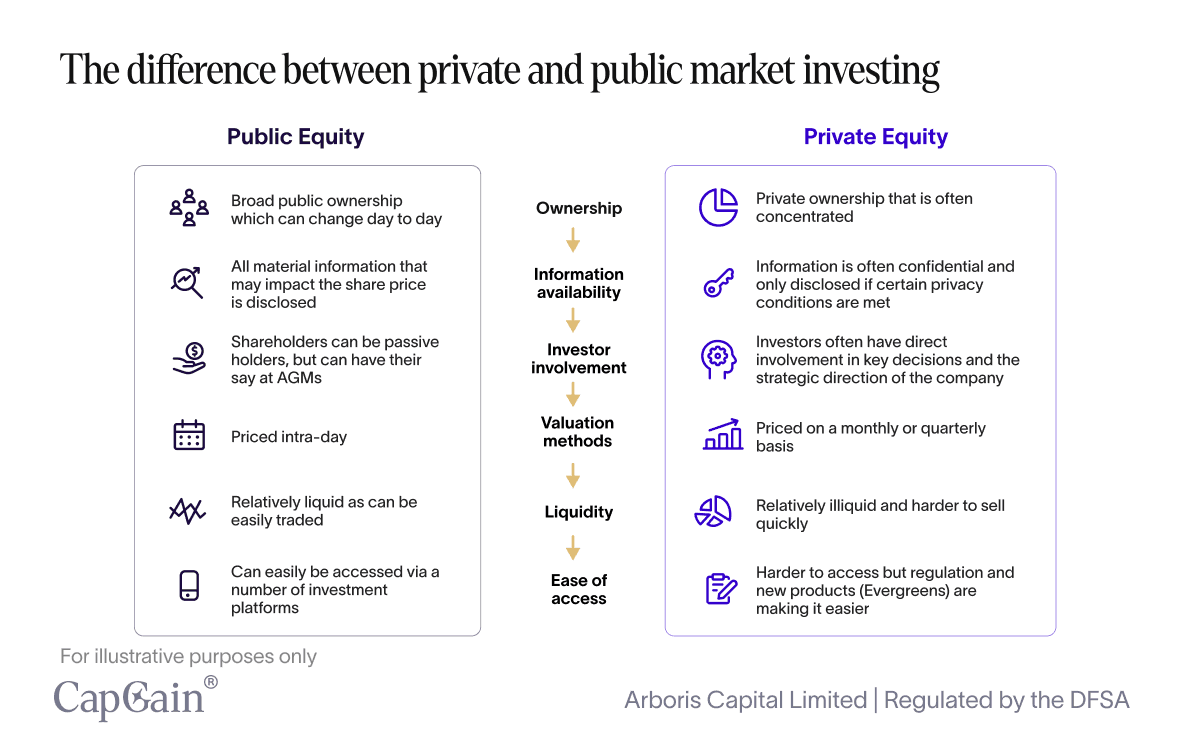
Public market dynamics: Transparency ≠ Equality
Because information plays such a crucial role in equity pricing, public markets enforce strict reporting requirements. Listed companies are legally required to disclose financials, risks, and other material facts on a regular basis. This transparency is designed to ensure that all investors—regardless of size and expertise—can access the same information and make decisions on an equal footing.
Meanwhile, disclosure doesn’t guarantee equal outcomes. Despite best efforts at market transparency, individual investors often lag behind their professional peers.
Public market mentality: Follow the leader
In public markets, information flows where attention flows. And money follows.
In an attempt to keep up with their institutional counterparts, many end up mimicking the moves of large institutions, assuming they have better information or sharper insight.
This “follow the leaders” dynamic can become self-fulfilling: the more capital flows toward certain companies, the more coverage they receive, the more data becomes available, and the traction they get.
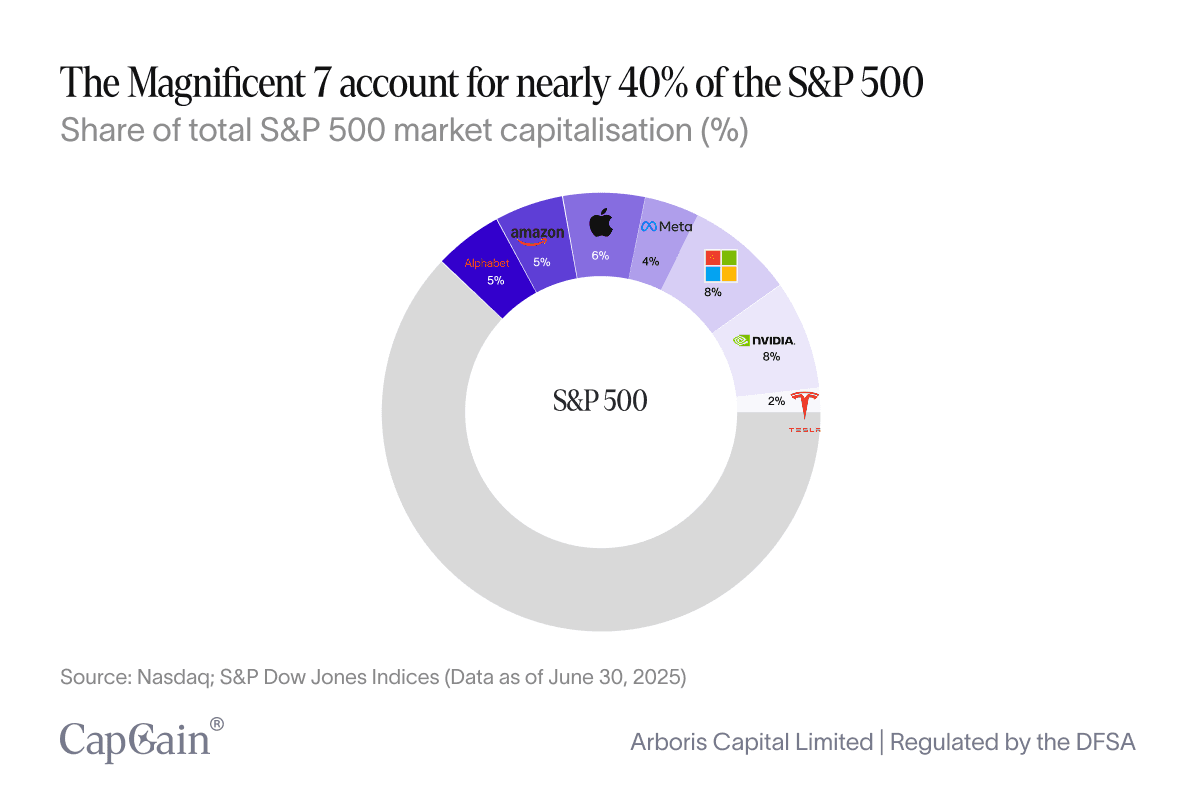
This dynamic often leads to market concentration in financial markets. A handful of dominant companies—the so-called “Magnificent 7”—now make up 38% of the S&P 500((1. Their visibility attracts investment, which in turn increases their price, attracting even more investment.
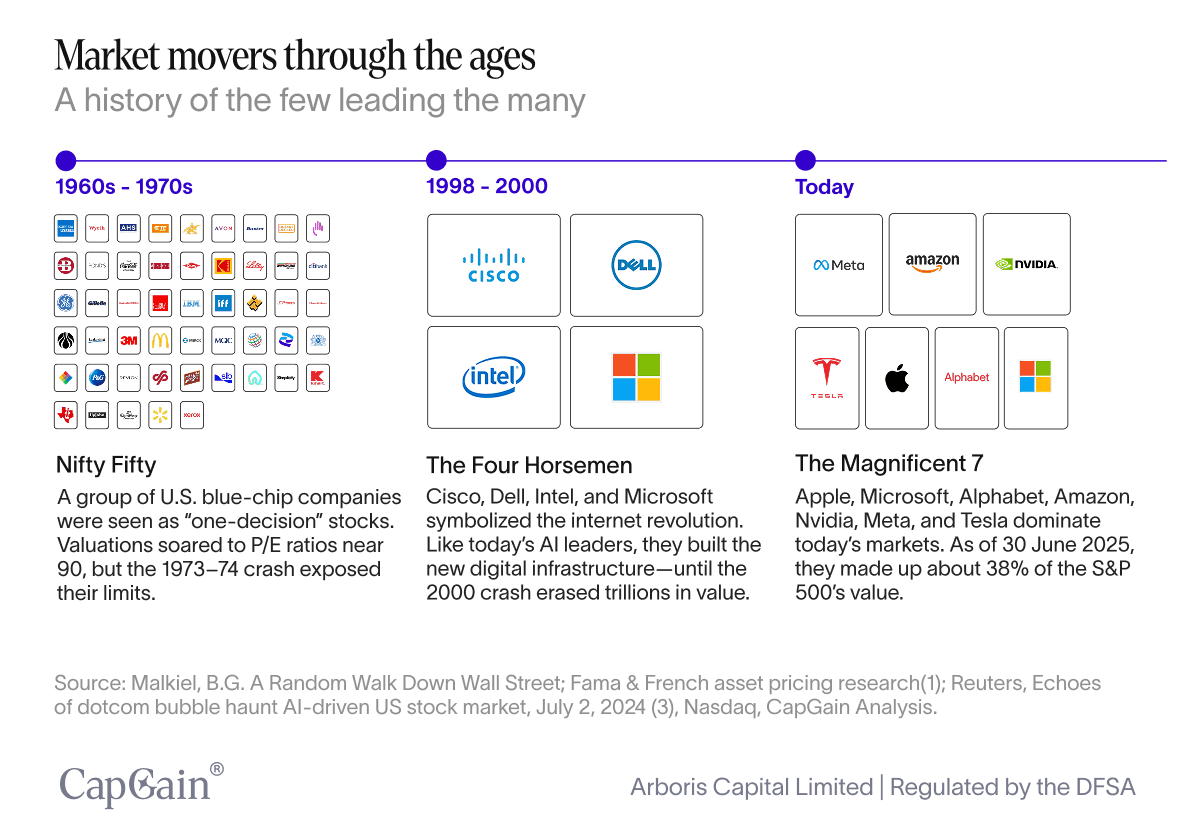
This is not the first time this has happened. In the lead up to the dot-com bubble, the four horsemen – Cisco, Dell, Intel, and Microsoft – dominated the market index. And in the late 60s and 70s it was… The Nifty Fifty.
Private equity: when information isn’t shared—it’s leveraged
In private markets, information plays an equally crucial role, but for different reasons.
In public markets, information is a determinant, setting the price based on market consensus. In private markets, information is an asset that creates value when acted on strategically.
Before investing in a company, private equity firms gain access to detailed financial information, operational data, and strategic conversations that are not publicly available. This information asymmetry allows them to identify undervalued businesses before others even know they exist.
Public equity rewards fast reaction to public data.
Private equity rewards deep analysis of private data.
One of the clearest signs of the different logic underpinning public and private markets? The prices investors are willing to pay.
According to McKinsey Global Private Market Report 2025, private equity firms have consistently paid lower valuation multiples than public market investors over the past 15 years ((4. In 2024, that gap widened once again. The average global buyout multiple sat at 11.9x EBITDA, while the MSCI World Index climbed to 13.1x. That’s a full 1.2x spread—a meaningful divergence in pricing.
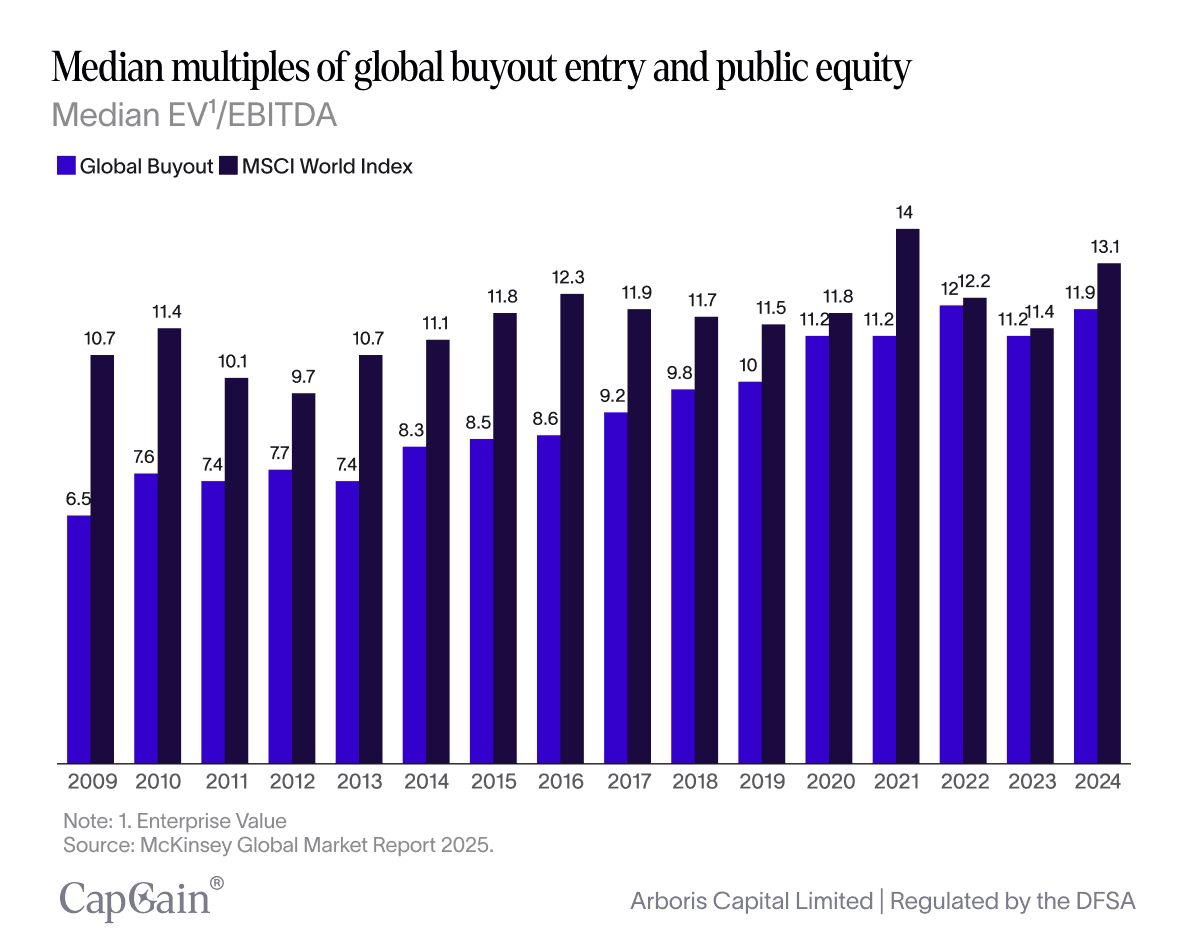
This pricing divergence reflects how each market processes information, attention, and risk.
Public market overvaluation: driven by hype cycles, media attention, and momentum-driven capital (especially into “it” sectors or fleeting fads).
Private market discipline: where firms face less competition per deal, conduct deep due diligence, and use proprietary insights to negotiate better entry prices.
In private markets, information reduces prices. In public markets, it inflates them.
From price takers to value makers: The private equity advantage
And once invested, private equity firms don’t just wait for prices to rise—they actively work to create value through operational improvements, governance, strategic shifts, or acquisitions.
Throughout this process, they leverage their network, access to proprietary market insights, and expertise accumulated through years, if not decades, of experience.
They don’t just sit on data—they operationalise it. With access to granular operational data, private equity firms identify exactly where and how a business can scale—whether it’s entering new markets, improving margins, reworking supply chains, or enhancing product offerings. Where public investors respond to market moves, private equity architects the next move.
Analysis based on market capitalisation data retrieved from Nasdaq.com for Nvidia, Meta Platforms, Tesla, Apple, Alphabet, Microsoft, and Amazon, as of June 30, 2025. Market cap figures reflect publicly available data accessed individually from each company's listing page on Nasdaq. “Magnificent 7” weighting calculated as the group’s combined market capitalisation divided by the total S&P 500 market capitalisation on that date.
Malkiel, B.G. A Random Walk Down Wall Street; Fama & French asset pricing research. Accessed July 17 2025. https://yourknowledgedigest.wordpress.com/wp-content/uploads/2020/04/a-random-walk-down-wall-street.pdf
Reuters, Echoes of dotcom bubble haunt AI-driven US stock market, July 2, 2024. Accessed July 17, 2025. https://www.reuters.com/markets/echoes-dotcom-bubble-haunt-ai-driven-us-stock-market-2024-07-02/
McKinsey - Global Private Market Report 2025

Written by
Sarah Hansen
Head of Research
Disclaimer – For Professional Clients Only
This communication is intended solely for persons classified as Professional Clients as defined by the Dubai Financial Services Authority (DFSA). It is not directed at Retail Clients and should not be relied upon by any person who does not meet the criteria for classification as a Professional Client. The information provided herein is for general informational purposes only and does not constitute, and should not be construed as, an offer, solicitation, invitation, or recommendation to buy, sell, or otherwise transact in any investment product or to engage in any investment strategy.
The subject matter discussed does not relate to a DFSA-regulated financial product or service. The content is intended only to provide a general update on market conditions and does not consider the specific investment objectives, financial situation, or particular needs of any recipient. It should not be relied upon as the basis for any investment decision. Past performance is not a reliable indicator of future performance. The value of investments and any income from them may fluctuate, and there is no assurance that the original capital will be preserved or returned.
Although the information contained in this communication has been obtained from sources believed to be reliable, Arboris Capital Limited makes no representation or warranty as to its accuracy, completeness, or fitness for any particular purpose. No liability is accepted by Arboris Capital Limited, its employees, or affiliates for any direct or consequential loss arising from the use of or reliance on this material. Arboris Capital Limited is authorised and regulated by the Dubai Financial Services Authority (DFSA) and operates within the Dubai International Financial Centre (DIFC), United Arab Emirates.